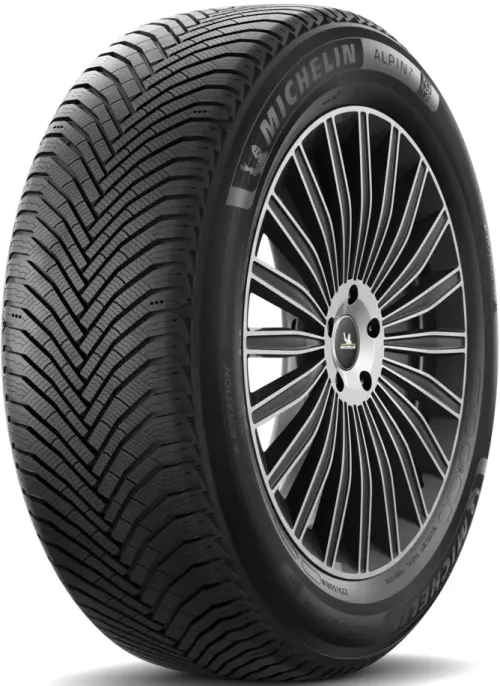
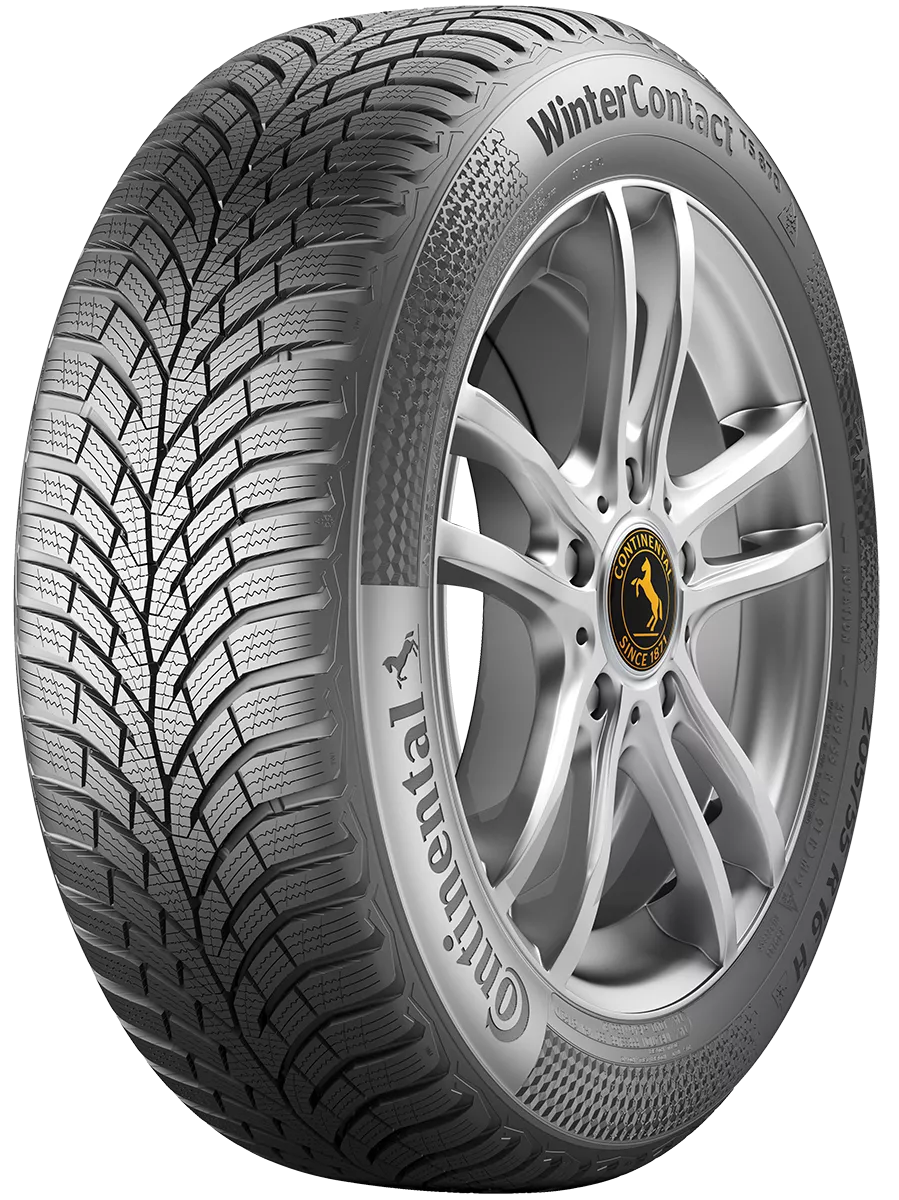
Continental delivers stronger all-weather confidence; Michelin counters with lower rolling resistance and assured snow handling.
The Continental WinterContact TS 870 and Michelin ALPIN 7 target drivers who want premium winter capability without sacrificing everyday usability. The Continental spans 43 dimensions from R14 to R18; the Michelin offers 49 from R15 to R20. Their biggest difference is character: the Continental combines precise road manners with strong rain protection, while the Michelin makes its strongest case through low rolling resistance, comfort and confident snow handling.
Continental positions the TS 870 as a winter specialist with wet-weather security and long life. The supplied data names the ContiWinterContact TS 850 as its predecessor. Michelin's ALPIN 7 follows the ALPIN 6, introducing additional sipes and an evolving tread pattern intended to maintain traction as it wears. Its results substantiate its efficiency credentials, although no direct predecessor comparison establishes the size of the improvement. Continental wins both shared tests: first against Michelin's fourth in both 205/55 R16 and 225/45 R17.
WinterContact TS 870
ALPIN 7


Averaged from 2 tests
Continental WinterContact TS 870
Michelin ALPIN 7
Continental WinterContact TS 870
Michelin ALPIN 7
Continental WinterContact TS 870
Michelin ALPIN 7
Continental WinterContact TS 870
Michelin ALPIN 7
Continental WinterContact TS 870
Michelin ALPIN 7Average wet braking distances are also unavailable, with zero measured stopping distances supplied for either tyre. Continental leads the wet-braking scores 88.3 to 80.3, although the overall wet scores are almost level at 86.7 and 86.3. That apparent tension matters: a broad category score can conceal differences between stopping, cornering and standing-water behaviour. Michelin earns praise for short wet stops in one assessment, while other feedback identifies weaker wet performance.
Continental's more persuasive advantage is the consistency of its rain capability. Its aquaplaning score is 93 against Michelin's 82, supported by longitudinal and lateral detail scores of 93.3 and 92.8. Its wet-circle score also leads, 95.1 versus 86.8. Continental attributes water management to Hydro Grooves and wet braking to its Cool Chili compound. The aquaplaning results support the drainage claim, although the summary's minor wet-braking criticism prevents describing every aspect as outstanding.
Michelin's wet-handling score of 90.7 sits close to Continental's 91.1, yet tester feedback exposes a more specific weakness: sluggish steering, pronounced understeer and earlier aquaplaning in bends. In practice, that means less willingness to tighten the line and a tendency to push wide when grip is stretched. Continental's repeated praise for precise wet behaviour, reinforced by enthusiastic owner feedback, makes it the better-supported choice for frequent heavy rain.
Continental WinterContact TS 870
Michelin ALPIN 7
Continental WinterContact TS 870
Michelin ALPIN 7Average dry braking distances cannot be calculated: the supplied dataset contains zero measured dry stopping distances for either tyre. The available braking scores favour Continental, 87.2 against 83.1, but these cannot be translated into metres or car lengths. The broader dry scores show a larger separation, 89.8 versus 80.6, suggesting that Continental's advantage extends beyond stopping performance into the way it responds when steering and braking demands build.
The strongest evidence concerns precision. Repeated assessments describe the Continental as secure and accurate on dry roads, supported by a 99.7 objective dry-handling detail score and 95 for lane changes. One owner also reports direct steering and excellent dry grip after 600km. Together, these support a tyre that responds clearly to inputs and inspires confidence when changing direction. They do not establish a quantified high-speed stability advantage or an ultimate-grip threshold.
Michelin receives positive feedback for balanced dry behaviour, with a dry-handling detail score of 87. That makes it a credible everyday choice, but the supplied evidence gives Continental the stronger case for drivers who value steering accuracy. The distinction is principally about demonstrated response and control; there is insufficient construction information to attribute it confidently to particular block stiffness or carcass differences.
Continental WinterContact TS 870
Michelin ALPIN 7
Continental WinterContact TS 870
Michelin ALPIN 7
Continental WinterContact TS 870
Michelin ALPIN 7No snow braking distances are supplied, so there is no defensible average stopping-distance comparison here either. Continental narrowly leads the broad snow scores, 90 to 88.7, but Michelin has compelling strengths within that category. Assessments praise its snow handling, cornering reserves and secure, dynamic behaviour, and one records the shortest snow braking distances among its candidates. Its snow-handling detail score is 91.
The latest shared test highlights why overall scores need context: Michelin finishes third for snow traction while Continental places ninth. Continental nevertheless has earlier praise for strong snow braking and traction, alongside a 96.7 snow-acceleration detail score; another assessment calls its snow handling average. The evidence therefore supports both as capable winter tyres, with Michelin particularly appealing for snowy cornering and the stronger traction result in that specific comparison.
Continental's Triple Sipe Concept is intended to improve winter control and braking. An owner describes reassuring progress on fresh and compacted snow, including climbs and descents, which adds useful real-world support. Ice evidence is limited to owner impressions and manufacturer positioning, without measured braking or handling comparisons. Both are classified as winter tyres, but explicit 3PMSF certification details are absent from the supplied data; neither should receive a claimed certification or an ice-performance advantage on that basis.
Continental WinterContact TS 870
Michelin ALPIN 7Michelin has the stronger comfort score, 93.2 against Continental's 88.8, plus a comfort detail score of 98.5. That supports its appeal to drivers prioritising ride comfort, although the data does not describe responses to particular bumps or road surfaces. Noise tells a different story: Continental leads the noise scores 95.5 to 91.9 and the interior-noise detail scores 98.7 to 95.7. In the latest shared test, Continental achieves the lowest cabin noise while Michelin ranks tenth.
Continental's refinement is not uniformly exceptional: earlier feedback calls cabin noise average. Nevertheless, seven owner mentions praise quiet running, giving its recent strong result some everyday backing. Its owner ratings reach 9.8/10 across 159 Heureka reviews and 89/100 across 24 Tyre Reviews submissions. No equivalent Michelin owner data is supplied, so those figures demonstrate Continental customer satisfaction rather than a comparative ownership victory.
Michelin's clearest running-cost advantage is rolling resistance: 95.7 against 86.8, backed by repeated best-in-test feedback. That supports lower energy demand, without establishing a fuel saving in litres or money. Its supplied fuel-label distribution is approximately 30% B, 66% C and 5% D, with rounding; Continental's is 77% C and 23% D. Wet labels are entirely B for Michelin, versus 82% B and 18% C for Continental, underlining that labels do not describe aquaplaning. Both attract premium-price criticism. Continental counters with a 90.3 mileage score, repeated low-wear praise and an owner reporting 21,744km over three seasons—not a measured end-of-life limit. Michelin lacks comparable mileage evidence here, making Continental's longevity case better established.
Continental WinterContact TS 870
Michelin ALPIN 7The Continental WinterContact TS 870 is the stronger default recommendation for mixed winter driving. Its two shared-test wins support a rounded package of accurate dry response, convincing wet control and stronger aquaplaning resistance. Choose it for a winter commute that alternates between dry roads, heavy rain and occasional snow, especially if steering confidence matters. Its substantial purchase price is easier to justify through the repeated mileage findings and supportive ownership reports.
Choose the Michelin ALPIN 7 when low rolling resistance, ride comfort and snowy-road handling dominate your priorities. Its efficiency advantage is particularly relevant to drivers covering substantial winter distances, while its latest traction result strengthens the case for regular snow use. Accept that the evidence shows weaker standing-water behaviour and less convincing wet steering, and does not establish superior lifetime mileage. Continental offers the more complete balance; Michelin is the more targeted choice for efficiency and snow capability.
Compare prices across all available dimensions for these tyres.
VS
VS
VS
VS
VS
VS
VS
VS
VS
VS
Continental WinterContact TS 870 vs Bridgestone Blizzak LM-005
Continental WinterContact TS 870 vs Michelin Alpin 6
Continental WinterContact TS 870 vs Pirelli Cinturato Winter 2
Continental WinterContact TS 870 vs Vredestein Wintrac
Michelin ALPIN 7 vs Bridgestone Blizzak 6
Michelin ALPIN 7 vs Vredestein Wintrac Pro+
Michelin ALPIN 7 vs Goodyear UltraGrip Performance 3