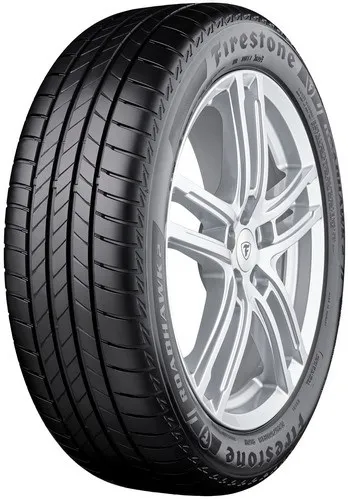
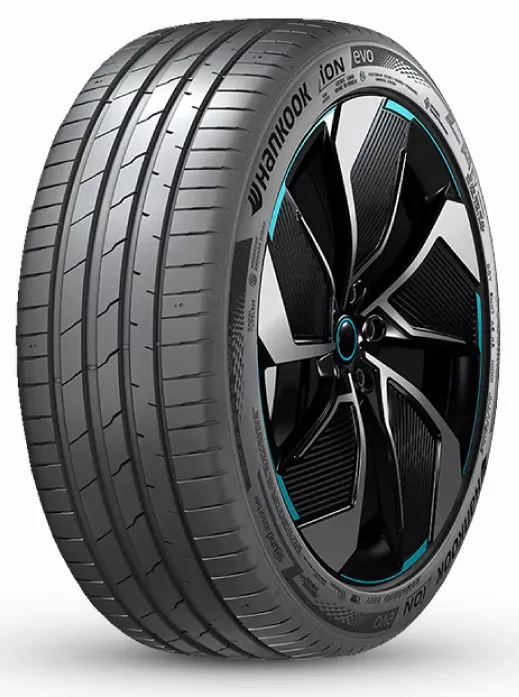
Hankook delivers stronger braking and control; Firestone counters with exceptional aquaplaning resistance, quietness and a lower price.
The Hankook ION Evo is a premium summer UHP tyre developed specifically around electric-vehicle demands: immediate torque, greater mass, range sensitivity and an unusually quiet powertrain. Hankook offers it in 55 sizes from R17 to R22, targeting electric sports cars and premium passenger cars. Its ProDurable compound and pressure-evening carcass are intended to resist the accelerated, uneven wear associated with EVs, while an aramid-reinforced belt and extended outer shoulder support high-speed shape stability and torque transfer.
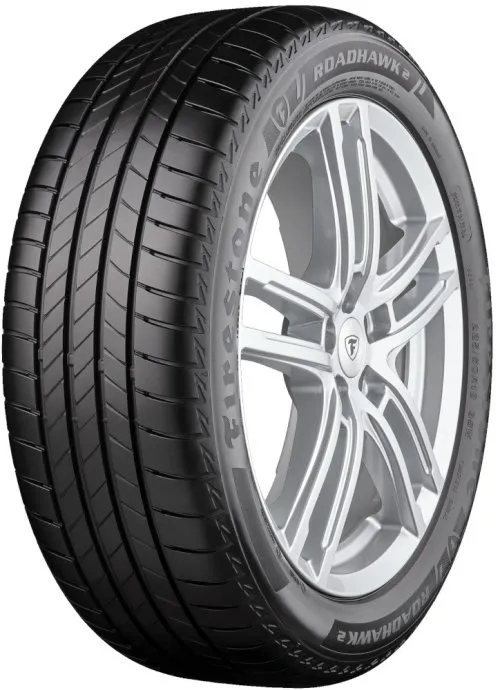
The Firestone Roadhawk 2 occupies the more affordable upper-middle segment. Available in 108 sizes from R16 to R22, it covers far more ordinary family cars and fleet applications while remaining EV-ready. It replaces the Firestone Roadhawk, with Firestone claiming 20% greater mileage and 12% lower rolling resistance than that predecessor. ENLITEN construction, a lightweight carcass and a high-silica NanoPro-Tech compound place efficiency and everyday versatility ahead of outright sporting ambition.
The defining difference is control margin. In their only direct test, the Hankook finished first of eight and earned an exemplary verdict; the Firestone placed sixth and was merely satisfactory. The ION Evo feels like a composed premium performance tyre engineered to manage an EV's weight and torque without sacrificing efficiency. The Roadhawk 2 is the quieter, cheaper everyday traveller, exceptionally resistant to aquaplaning but less convincing when asked to brake hard, communicate through the steering or recover from abrupt load changes.
ION Evo
Roadhawk 2


Hankook ION Evo
Firestone Roadhawk 2
Hankook ION Evo
Firestone Roadhawk 2
Hankook ION Evo
Firestone Roadhawk 2
Hankook ION Evo
Firestone Roadhawk 2
Hankook ION Evo
Firestone Roadhawk 2No valid head-to-head average wet braking distance is available because the data supplies no measured Hankook distance. Firestone recorded 38.3 metres in one wet-braking test and 51.1 metres in another, averaging 44.7 metres across those two measured results; that is a Firestone-only average, not a direct comparison. Its wet-braking score is 66.7, whereas Hankook's is 97. The ION Evo is consequently the much stronger emergency-stopping proposition, supported by its short-braking test feedback and EU wet-grip distribution of 95% A-rated sizes, 3% B and 2% C.
Firestone's wet character is unusually split. Almost every size, 99%, carries an EU A wet-grip label, yet the independent results show that this label does not guarantee class-leading wet braking or handling. Wet handling scores 79.7 and wet-circle cornering 76, while testers found restricted adhesion reserves, weak steering information and unstable behaviour during load changes, particularly on wet asphalt. From 100 km/h, its 44.7-metre two-test average represents roughly nine car lengths of stopping space. The practical message is to preserve a larger gap even though the label and normal-speed behaviour appear reassuring.
Standing water is where the Roadhawk 2 becomes exceptional. It scores 91.2 in longitudinal aquaplaning and 94 across transverse aquaplaning, won both aquaplaning disciplines in one comparison and produced a class-leading 2.44 m/s² in the curved-water test. Wide shoulder lugs, chamfered sipes and optimized void-to-rib proportions give displaced water an efficient escape path. Hankook is also strong, scoring 82 for aquaplaning and receiving praise for good safety reserves, but Firestone is the specialist choice in cloudbursts and deep motorway ruts. On a merely wet, twisting road, however, Hankook's 88.8 overall wet score and superior braking authority provide the more coherent, confidence-building package.
Hankook ION Evo
Firestone Roadhawk 2
Hankook ION Evo
Firestone Roadhawk 2A comparable average dry braking distance cannot be calculated from the supplied results: no measured Hankook distance is provided, while the Firestone's available evidence includes 35.4 metres in one test, where it finished last, plus a seventh-place dry-braking result elsewhere. It would therefore be misleading to manufacture a two-tyre average or claim a precise stopping gap. The scoring nevertheless separates them clearly: Hankook records 91 for dry braking and 91.5 overall dry performance, against 66.5 and 61.5 respectively for Firestone.
That difference should be most apparent during emergency braking and fast direction changes. The ION Evo's aramid reinforcement is designed to limit tread deformation at speed, while its extended outer shoulder blocks resist the slip generated by an EV's instant torque. More uniform contact pressure also helps keep a larger, more consistent footprint working under braking. The result indicated by the tests is not merely greater peak grip but better-managed grip: short braking, excellent dynamics and enough structure to keep a heavy car settled through rapid steering inputs.
The Roadhawk 2 remains secure enough for normal road use, with a 73.8 dry-handling score, 80 for the dry lane-change discipline and positive evidence of good cornering safety. Its weakness is the transition from everyday pace to the limit. Steering response can be delayed, feedback weak and ultimate adhesion limited; long dry stopping distances reinforce that impression. Connected shoulder blocks distribute pressure effectively, but its efficiency-led lightweight construction and touring priorities do not produce the Hankook's braking authority or immediacy. Drivers will feel this as an extra pause before the tyre takes a set and less information as grip runs out.
Hankook ION Evo
Firestone Roadhawk 2Firestone has the numerical advantage in refinement, scoring 79.8 for comfort and 83.2 for noise, compared with Hankook's 72 and 66. It was the quietest tyre in one test, so its broad touring brief is more than marketing. There are qualifications: another assessment identified slightly poorer impact comfort, and passing noise was not always outstanding. Even so, its general character is calm and unobtrusive. That suits long trips, family cars and drivers who rarely approach the adhesion limit.
Hankook counters with technology tailored to the near-silence of an EV cabin. Its internal i Sound Absorber foam is intended to suppress the hollow cavity resonance that becomes conspicuous without engine noise, while Opti Pitch varies tread-block sequencing to reduce tonal noise. Tests describe its comfort as good, but the aggregate noise score shows that the claimed refinement is not universally dominant. Owners are divided too: some call it quiet and comfortable, while others regard its grip as only average beside Michelin Pilot Sport 4 or 5 and markedly below Bridgestone Potenza Sport. Reports of slip during acceleration or cornering remind buyers that an EV-specific balance is not the same as maximum sports-tyre grip, despite the strong controlled-test scores.
Running-cost evidence is more complicated. Hankook scores 82 for mileage against Firestone's low 38, and its ProDurable compound plus Round Even Technology directly target the approximately 20% faster uneven wear that Hankook associates with EV use. Its fuel labels are also excellent: 52% of sizes achieve A, 45% B and only 3% C. Firestone's range is predominantly B-rated for efficiency at 70%, with 27% C and just 3% A. It nevertheless recorded a best-in-test 8.0 kg/t rolling resistance in one comparison and has a higher aggregate rolling-resistance score, 74.8 versus 69. Conflicting feedback elsewhere found high resistance and consumption, illustrating how size, vehicle and test method matter.
Firestone's lower purchase position is tangible: one test listed it at €132, and its 108-size range makes fitment easier. Yet low entry price does not automatically mean low lifetime cost. Although Firestone claims 20% more mileage than the original Roadhawk, independent evidence still flags distinctly restricted longevity. Hankook's better mileage score, more consistently strong fuel labels and ability to control EV wear make it the stronger long-term value for a powerful or heavy electric car. Firestone offers attractive immediate value for moderate-mileage drivers, particularly where purchase price and quiet cruising matter more than replacement interval.
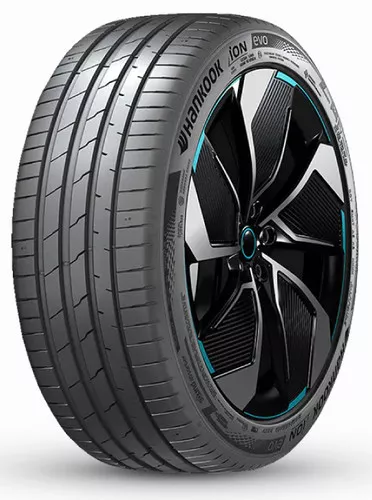
Hankook ION Evo
Firestone Roadhawk 2
Hankook ION Evo
Firestone Roadhawk 2The Hankook ION Evo is the clear overall recommendation. It won the sole direct comparison, finishing first while Firestone placed sixth, and its decisive advantages lie in the disciplines that matter most when something goes wrong: braking, balanced wet grip and controllable high-speed dynamics. Choose it for a premium EV, a powerful saloon or an SUV whose weight and torque place unusual demands on its tyres. It also makes sense for high-mileage drivers because its 82 mileage score, predominantly A/B efficiency labels and even-wear engineering can offset the premium purchase position.
Choose the Firestone Roadhawk 2 when priorities are price, low cabin noise, broad size availability and exceptional resistance to standing water. Its aquaplaning results are genuinely outstanding, and it remains a capable everyday tyre at sensible speeds. It is particularly persuasive for a family car driven in a rainy climate where flooded motorway tracks are common, provided the driver leaves generous braking space. Its drawbacks are longer stopping distances, lower adhesion reserves, delayed steering response and questionable wear value, so it is not the tyre for aggressive driving or repeated emergency-margin demands.
There is no contradiction in calling Firestone the better deep-water specialist while recommending Hankook overall. Aquaplaning resistance describes how long a tread can keep cutting through standing water; it does not guarantee short braking once the road is simply wet. Hankook combines fewer dramatic weaknesses with much stronger braking scores and better longevity evidence. Firestone wins on refinement, affordability and water evacuation, but Hankook delivers the more complete and reassuring safety-performance balance.
| Organization | Season | Year | Dimension | |
|---|---|---|---|---|
Autobild | Summer | 2025 | 215/55 R18 | View |
Compare prices across all available dimensions for these tyres.
VS
VS
VS
VS
VS
VS
VS
VS
VS
VS
Hankook ION Evo vs Michelin Primacy 4+
Hankook ION Evo vs Goodyear EfficientGrip 2 SUV
Hankook ION Evo vs Continental PremiumContact 7
Hankook ION Evo vs Falken E.Ziex
Firestone Roadhawk 2 vs Kumho Ecsta PS71
Firestone Roadhawk 2 vs BFGoodrich Advantage
Firestone Roadhawk 2 vs Uniroyal RainSport 5
Firestone Roadhawk 2 vs BF Goodrich Advantage 2