Comparison: Vredestein ULTRAC vs. Hankook Ventus Prime 4 (2026)
Also compare with
Hankook wins seven of nine head-to-heads; the ULTRAC answers only in standing water.
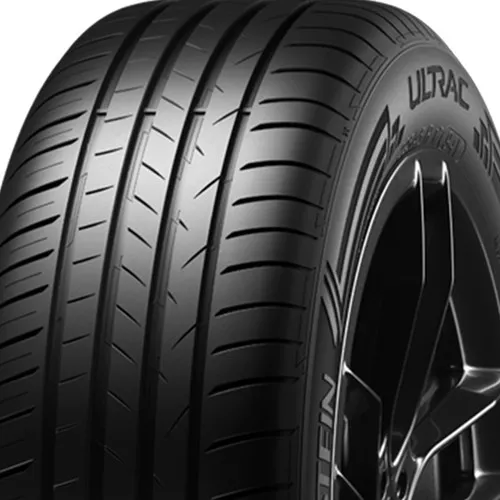
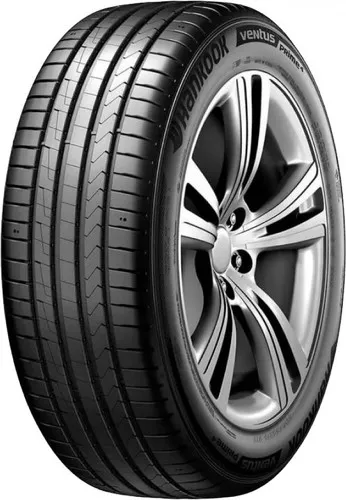
On paper, this looks like a contest between two premium summer tyres pitched at similar buyers — family hatchbacks, compact crossovers, everyday drivers who want more than a budget tyre without paying supercar money. In practice, Vredestein's ULTRAC and Hankook's Ventus Prime 4 have developed into meaningfully different tools. The ULTRAC sits at the base of Vredestein's summer passenger hierarchy — beneath the Ultrac+ and the flagship Ultrac Pro — and its design brief centres on wet safety and refinement rather than outright dynamics or economy. The Ventus Prime 4 succeeds the Hankook Ventus Prime3 K125 and carries a more ambitious mandate: balanced, broadly capable performance at a price point that undercuts much of the traditional premium field, available in 97 sizes spanning R13 to R22 versus the ULTRAC's 66 sizes across R15 to R21.
The headline difference in character is this: the ULTRAC is a wet-weather specialist with a particular gift for aquaplaning resistance, genuine cabin refinement, and a forgiving, predictable manner that suits relaxed everyday driving. The Ventus Prime 4 is the more complete all-rounder — better on mileage, rolling resistance, dry dynamics, and noise in most configurations — and it proves the point with a 7–2 record across nine mutual comparative tests. Our own rating reflects that gap: 76/100 for the Hankook against 43/100 for the Vredestein. That said, the ULTRAC's advantages in standing water are real, and for the right driver in the right car, they matter enormously.
Both tyres carry OE approvals — the ULTRAC holds fitment approval on the BMW 2 Series Active Tourer and is made in Hungary — while the Ventus Prime 4 has earned EU label A-ratings for wet grip across the majority of its range. Understanding which tyre suits you comes down to how you drive, what you drive, and how many kilometres a year you cover.
 ULTRAC
 Ventus Prime 4


These tyres were not tested together in the same test. The scores below are aggregated from different independent tests, so direct comparison should be taken with caution.
 Hankook Ventus Prime 4Vredestein ULTRACHankook Ventus Prime 4Vredestein ULTRACHankook Ventus Prime 4Vredestein ULTRACHankook Ventus Prime 4
The dry braking figures are remarkably close. Averaged across two measured braking tests, the Vredestein ULTRAC stops in 36.1 metres and the Hankook Ventus Prime 4 in 35.9 metres — a gap of 0.2 metres that is statistically negligible and, from 100 km/h, represents less than a tenth of a car length. In the Auto Bild 2024 205/55 R16 mega-brake test across 55 tyres, the ULTRAC finished third and the Ventus Prime 4 fourth, both within a very tight cluster at the top. In the 2022 215/55 R17 equivalent over 51 tyres, the Ventus Prime 4 finished second (35.8m) and the ULTRAC fourth (36.1m). So on this single metric, both tyres are genuinely competitive and separated by a margin that has no real-world consequence.
Where the Ventus Prime 4 pulls clearly ahead is in dry handling dynamics. Its dry-handling-objective score of 97.5 in detailed test assessments towers over the ULTRAC's best comparable dry score, and testers describe its dry character as dynamic, neutral, and confidence-inspiring through direction changes. The ULTRAC, by contrast, draws consistent criticism for a bouncy handling character in the dry, a slower rear axle response to quick direction changes, and a mild understeer tendency that becomes more pronounced in sportier or lower-profile sizes. These are not catastrophic failings — testers generally describe the ULTRAC as safe and manageable in dry conditions — but drivers who enjoy a progressive, connected feel through bends will find the Ventus Prime 4 noticeably more rewarding. In the Aftonbladet 2025 225/45 R17 comparative, the Ventus Prime 4 placed sixth of ten on dry grip and handling; the ULTRAC placed seventh, consistent with that slight dynamic deficit.
In comprehensive dry tests where handling, high-speed stability and lane-change response are all weighted alongside braking, the gap widens considerably. The ADAC 2024 215/55 R17 test is the starkest illustration: the Ventus Prime 4 placed eighth of sixteen with a satisfactory verdict, while the ULTRAC placed last — sixteenth of sixteen — rated merely adequate. The Auto Bild 2024 20-tyre 205/55 R16 comparison told a similar story: Ventus Prime 4 eighth, ULTRAC twentieth. These results confirm that while the ULTRAC's stopping power is real, its overall dry competence falls away when dynamic precision, load sensitivity and response are factored in.
Hankook Ventus Prime 4Vredestein ULTRACHankook Ventus Prime 4Vredestein ULTRACHankook Ventus Prime 4Vredestein ULTRACHankook Ventus Prime 4Vredestein ULTRACHankook Ventus Prime 4Vredestein ULTRACHankook Ventus Prime 4Vredestein ULTRACHankook Ventus Prime 4This is where the comparison genuinely becomes a contest. In wet braking, averaged across the same two measured tests, the Vredestein ULTRAC actually leads: 27.4 metres versus 27.8 metres for the Hankook Ventus Prime 4 — a gap of 0.4 metres, or roughly a quarter of a car length from 80 km/h. In practical terms, this means the ULTRAC brings a vehicle to rest in heavy rain marginally earlier, an edge that becomes meaningful in genuine emergency situations. In the 2024 Auto Bild braking test, the ULTRAC recorded 26.6m wet and the Ventus Prime 4 27.7m — a full metre of advantage. In the 2022 test, the gap narrowed to 0.4 metres (28.2m vs 27.8m, slightly favouring the Hankook). These two data points suggest the ULTRAC's wet braking edge is most pronounced in certain size configurations and conditions, but is real across both measured tests.
The aquaplaning picture is where the ULTRAC's character becomes unmistakable. Its aquaplaning score of 86.6 — against the Ventus Prime 4's 74.4 — is not a marginal difference; it is a 12-point chasm that reflects fundamentally different tread architecture priorities. The ULTRAC's aquaplaning-longitudinal detail score of 88.1 and cross-aquaplaning score of 85.1 confirm that it channels standing water efficiently in both straight-line and cornering scenarios. Tyre Reviews named it best in test for aquaplaning resistance in 2023. The Ventus Prime 4's lower aquaplaning score is corroborated by the 2025 Aftonbladet results — where it was commended for wet handling but not aquaplaning — and by ADAC noting a noticeably weaker wet performance for the Hankook in 2026. Drivers who regularly encounter flooded roads, heavy summer rain, or standing water on motorways should take this gap seriously.
On wet handling more broadly, both tyres are competent, but the ULTRAC again leads in objective terms: its wet-handling-objective score of 92.3 compares to 87.5 for the Ventus Prime 4, and its wet-circle-cornering scores are also marginally higher. Real-world owners of the ULTRAC confirm this feel — the tyre inspires confidence in the wet with predictable, gradual breakaway behaviour and stable lateral grip. The Ventus Prime 4 is not unsafe in the wet; testers describe neutral, secure wet handling and adequate cornering reserves. But in a straight comparison in standing water and heavy rain, the ULTRAC is the tyre you want under you.
Hankook Ventus Prime 4Vredestein ULTRACHankook Ventus Prime 4Vredestein ULTRACHankook Ventus Prime 4Vredestein ULTRACHankook Ventus Prime 4Ride comfort is one of the ULTRAC's strongest suits by reputation, and owner experience largely bears this out. A Kia Ceed driver reported outstanding softness even on that model's firm first-generation suspension — describing the ULTRAC as softer than his winter tyres — and multiple test organisations have highlighted its comfortable, absorbent character over imperfect surfaces. However, the picture is not entirely consistent: Automotorsport flagged a slight potriness over rough road surfaces, and a Skoda Yeti owner running the tyre for 35,000 miles found it not particularly comfortable. The ULTRAC's comfort performance score of 78.7 is solid but not exceptional; the Ventus Prime 4 scores 80.0. In dedicated noise testing, the ULTRAC's detail score of 96.5 in the tests where it was measured reflects genuinely outstanding cabin refinement — Tyre Reviews confirmed class-leading noise levels in 2025 — but its overall noise performance score of 71.4 suggests this varies significantly by size and surface, with some formats generating elevated external pass-by noise.
The Ventus Prime 4 is more predictable on noise: interior and exterior noise detail scores of 77 and 78 respectively reflect consistent, if unspectacular, refinement across its range. One Motor 2026 test did record it as the loudest tyre in the group at 75.5 dB, so it is not flawless on this metric, but across a broader sample it is the more dependable choice for drivers who want consistent cabin quiet across multiple size options. On rolling resistance — which drives both fuel costs and range for hybrid and mild-hybrid vehicles — the Ventus Prime 4 holds a meaningful advantage: 75.0 against the ULTRAC's 66.3. The Hankook earns EU label B ratings for fuel efficiency across a significant portion of its range; the ULTRAC's higher rolling resistance has been flagged by multiple independent tests including ADAC and Auto Bild, and will cost drivers measurably more in fuel over the life of the tyre.
Mileage is where the ULTRAC's economics become genuinely difficult to defend. Its mileage score of 45.3 is among the lowest in the premium segment — ADAC recorded high abrasion in multiple test cycles and rated it accordingly. The Ventus Prime 4 scores 74.2 on mileage, a gap of nearly 30 points that translates to materially longer tread life in real-world use. The Skoda Yeti owner who called the ULTRAC hard-wearing at 35,000 miles is an outlier; the Honda Civic Type R owner who ran the same tyre for 35,000 miles gave a much harsher verdict overall and found the tyre had deteriorated significantly. The Ventus Prime 4 is priced at a moderate level relative to other Korean-origin premium tyres and offers substantially better cost-per-kilometre on account of its superior mileage and lower rolling resistance. For high-mileage drivers, the difference in total running cost over the life of a set could comfortably exceed the price of an extra set of tyres.
Hankook Ventus Prime 4Vredestein ULTRACHankook Ventus Prime 4Vredestein ULTRACHankook Ventus Prime 4Vredestein ULTRACHankook Ventus Prime 4The data produces a clear and honest verdict. The Hankook Ventus Prime 4 is the better tyre for the majority of drivers. It wins seven of nine head-to-head tests, scores higher on dry dynamics, mileage, rolling resistance, and overall balance, and carries a user satisfaction rating of 91/100 from 37 independent owners — a figure that reflects a product delivering consistently on its promise. Drivers of compact family cars, hatchbacks and small crossovers covering typical annual mileages who want a premium summer tyre with strong all-round credentials, good fuel economy, and reliable wet and dry safety will find the Ventus Prime 4 the more sensible, more rewarding, and ultimately more economical choice. Its predecessor, the Ventus Prime3 K125, was well-regarded; the Prime 4 represents a genuine step forward in dry dynamics and rolling resistance while maintaining the balanced character that made its predecessor popular.
The Vredestein ULTRAC earns its place in a narrower but legitimate set of circumstances. If you drive on roads prone to flooding and standing water, its aquaplaning resistance — 12 points higher than the Ventus Prime 4 on our composite score, and best in test in multiple 2023 and 2024 assessments — is a genuine, potentially safety-critical advantage. Its wet braking edge of 0.4 metres on average is modest but real. Its cabin refinement can be class-leading in the right size — the 205/55 R16 in particular — making it an appealing choice for refinement-focused drivers of standard family cars. BMW's OE approval for the 2 Series Active Tourer suggests it suits mild-mannered, comfort-oriented applications well. The problem is its mileage and rolling resistance, which undermine its value case severely for anyone covering more than moderate annual distances.
Driver profile is the deciding factor. If you own a hot hatch, a performance-oriented car, or a vehicle where dynamic precision and sidewall feel matter to you, the ULTRAC is the wrong choice — the Honda Civic Type R owner who rated it 27/100 after 35,000 miles makes this abundantly clear. If you prioritise longevity, fuel economy, or sporty dry feel, step up to the Ultrac+ or Ultrac Pro within the Vredestein range, or buy the Ventus Prime 4. If you live in a region with frequent summer storms, drive a sensible family car, cover modest annual mileage, and want the best possible aquaplaning protection available at the ULTRAC's price point, that tyre remains a defensible choice. For everyone else, the Hankook is the smarter buy.
Compare prices across all available dimensions for these tyres.
| Organization | Season | Year | Dimension | |
|---|---|---|---|---|
 Aftonbladet Aftonbladet | Summer | 2025 | 225/45 R17 | View |
 Autobild Autobild | Summer | 2024 | 225/55 R17 | View |
| Autobild | Summer | 2024 | 205/55 R16 | View |
| Autobild | Summer | 2024 | 205/55 R16 | View |
 ADAC ADAC | Summer | 2024 | 215/55 R17 | View |
 Autoklub ČR Autoklub ČR | Summer | 2023 | 205/55 R16 | View |
 Tyre Reviews Tyre Reviews | Summer | 2023 | 205/55 R16 | View |
| Autobild | Summer | 2022 | 215/55 R17 | View |
| Autobild | Summer | 2022 | 215/55 R17 | View |
 VS
VS
 VSVSVS
 VSVS
VSVS VSVSVSVS





