Comparison: Continental PremiumContact 6 vs. Goodyear Efficientgrip 2 SUV (2026)
Also compare with
Goodyear dominates comfort and durability; Continental fights back with superior dry braking grip.
These two premium summer tyres occupy very different niches despite sharing a segment. The Continental PremiumContact 6 is a broadly-focused premium summer tyre from Continental — the German giant's response to drivers who want sporting dynamics wrapped in everyday civility. It succeeds the ContiPremiumContact 5 and covers an impressive 120 dimensions from R15 to R22, with production spread across Germany, Slovakia, and the Czech Republic. Crucially, it has already been superseded by the Continental PremiumContact 7, which means the PC6 is now a closing-line proposition: excellent engineering at potentially compelling prices as stocks clear.
The Goodyear Efficientgrip 2 SUV is an entirely different beast — a purpose-engineered SUV tyre built from the ground up around the specific demands of raised, heavier vehicles. Where the Continental is a generalist performer that happens to fit SUVs in larger sizes, the Goodyear is an SUV specialist first and last. Its 44-dimension lineup covers R16 to R22, manufactured in Slovenia, and it builds on the original Goodyear Efficientgrip SUV with meaningfully improved balance across all metrics. Our rating of 92/100 — nine points above the Continental's 83/100 — reflects not just test wins but a coherence of purpose: comfort, quiet, durability, and safety in one package.
The single biggest character difference between these two tyres is this: the Continental PremiumContact 6 is a driver's tyre that happens to be comfortable, while the Goodyear Efficientgrip 2 SUV is a comfort tyre that happens to be very safe. The Continental rewards engagement — it brakes harder on dry roads and turns in with more directness. The Goodyear rewards patience — it glides over surfaces, barely registers in the cabin, and outlasts most rivals by a wide margin. Choosing between them is really a question of what you value most in an SUV tyre.
 PremiumContact 6
 Efficientgrip 2 SUV


These tyres were not tested together in the same test. The scores below are aggregated from different independent tests, so direct comparison should be taken with caution.
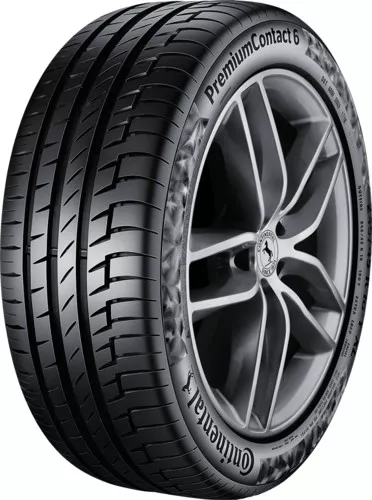
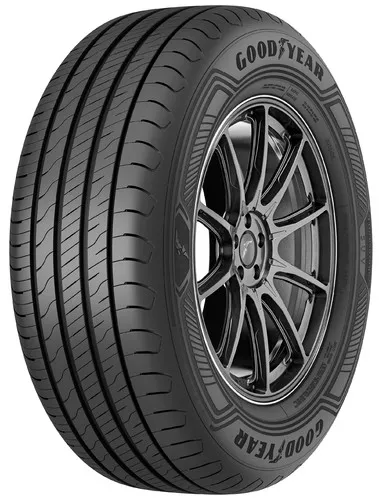 Continental PremiumContact 6Goodyear Efficientgrip 2 SUVContinental PremiumContact 6Goodyear Efficientgrip 2 SUVContinental PremiumContact 6Goodyear Efficientgrip 2 SUV
On dry tarmac, the Continental PremiumContact 6 holds a clear and meaningful advantage. Its dry performance score of 90.3 compares to 84.1 for the Goodyear — a gap of 6.2 points that translates directly into shorter stopping distances and more confidence at the limit. The dry braking score tells the sharpest story: Continental registers 91.8 versus the Goodyear's 82.1, a near ten-point gulf that is among the largest single-metric differences between the two tyres. In the Motor 2026 SUV test, the Goodyear recorded a dry braking distance of 36.3 metres from 100 km/h, placing it sixth — a result that puts its stopping capability behind several rivals in that field. The Continental, in various test cycles, has consistently been benchmarked among the class leaders for dry stopping, with its dry-lane-change score of 94.6 and dry-handling score of 91.9 indicating a tyre that is genuinely tied to the road in dynamic situations.
The reasons for this dry advantage come down to compound chemistry and tread architecture. The Continental's compound is tuned for maximum dry-road friction, generating the kind of progressive, confidence-inspiring grip that testers consistently describe as offering broad safety margins on both wet and dry surfaces. The dry-steering reaction score of 91.0 confirms that the Continental communicates well — turn-in is crisp and the tyre builds lateral force quickly. The Goodyear, by contrast, has been noted for slightly less responsive steering, a deliberate trade-off that prioritises ride isolation over immediacy of response. Real-world drivers who have switched to the Goodyear from sportier tyres often note a softer, more detached feel through the wheel — comfortable, but lacking the direct dialogue that enthusiast drivers prefer.
It is worth noting that the Continental does exhibit a mild understeer tendency at the limit, and some testers have observed that it leans on the front axle when pushed hard — a characteristic of its comfort-premium origins rather than a pure track tyre. The dry-handling-measured score of 87.4 is a touch below the subjective dry-handling figure of 91.9, suggesting the lap times are slightly less stellar than the feel implies. But in real-world SUV driving, the Continental is simply the safer, more capable dry-weather tyre. If you regularly brake hard approaching junctions, carry speed into motorway sliproads, or simply want the most margin between you and the car in front, the Continental's dry-road capability is the clinching argument.
Continental PremiumContact 6Goodyear Efficientgrip 2 SUVContinental PremiumContact 6Goodyear Efficientgrip 2 SUVContinental PremiumContact 6Goodyear Efficientgrip 2 SUVContinental PremiumContact 6Goodyear Efficientgrip 2 SUVContinental PremiumContact 6Goodyear Efficientgrip 2 SUVContinental PremiumContact 6Goodyear Efficientgrip 2 SUVWet performance is where the contest narrows dramatically and becomes more nuanced. The Continental PremiumContact 6 scores 84.0 overall in wet conditions with a wet braking score of 90.7, while the Goodyear Efficientgrip 2 SUV scores 84.5 overall with a wet braking score of 86.3. On the face of it, the Continental stops shorter in the wet — but the overall wet score marginally favours the Goodyear, and the reason is aquaplaning. The Continental's aquaplaning score of 73.4 is a genuine weak point, sitting well below the Goodyear's 81.8. This 8.4-point difference in aquaplaning resistance is significant: it means that at higher speeds on flooded roads, the Goodyear's tread channels evacuate water more efficiently, keeping the contact patch engaged with the road for longer before the tyre lifts off the surface entirely.
The Goodyear's EU label wet grip rating reinforces this picture emphatically: 98% of its variants achieve an A-grade, the highest possible classification, compared to 83% for the Continental (with 17% rated B). In practical terms, the Goodyear is the safer tyre in heavy, sustained rainfall — particularly for an SUV's higher centre of gravity, where aquaplaning events are more destabilising than in a low-slung saloon. In a 2026 SUV group test by Motor, the Goodyear claimed first place for wet handling with a perfect score, confirming that its wet-road composure extends beyond straight-line braking into dynamic cornering on damp surfaces. Its wet-handling score of 88.3 and wet-circle-cornering score of 82.4 both edge the Continental's equivalents.
The Continental's aquaplaning weakness has appeared across multiple test cycles and should not be dismissed. Some testers have explicitly noted reduced safety reserves at aquaplaning speeds and extended wet braking distances in conditions with heavy standing water. In normal wet-road driving — damp motorways, light urban rain — the Continental performs very well and its wet braking is genuinely class-competitive. But in the worstcase scenario of a sudden summer downpour on a motorway, the Goodyear's superior water evacuation provides a meaningful additional safety buffer. For SUV drivers who encounter high-speed standing water, that is not a trivial difference.
Continental PremiumContact 6Goodyear Efficientgrip 2 SUVContinental PremiumContact 6Goodyear Efficientgrip 2 SUVContinental PremiumContact 6Goodyear Efficientgrip 2 SUVContinental PremiumContact 6Goodyear Efficientgrip 2 SUVThis is where the Goodyear Efficientgrip 2 SUV makes its most emphatic statement. Its comfort score of 92.3 against the Continental's 78.7 is a 13.6-point gap — the largest single-category difference between these two tyres and one of the most dramatic comfort disparities you will find between two premium summer tyres in the same segment. The noise score is even more striking: 96.9 for the Goodyear versus 75.2 for the Continental, a difference of 21.7 points. In subjective terms, the Goodyear is one of the quietest SUV tyres on the market — owners on the Peugeot 3008 and BMW X3 consistently report a cabin that feels dramatically more refined compared to tyres they've replaced. One owner, switching from a Continental CSC6, specifically highlighted the step-change in ride absorption and overall refinement. The Continental, meanwhile, has received some user complaints about noise levels — a minority view, but representative of a tyre that is not primarily engineered around cabin quietness.
Rolling resistance follows the same pattern. The Goodyear scores 78.0 versus 75.1 for the Continental — a modest gap, but backed up by EU label data that tells a clearer story: 65% of Goodyear's variants carry a B fuel efficiency rating (with 9% reaching A), while 57% of Continental's variants are rated C with only 5% achieving A. Over 30,000 kilometres of mixed driving in an SUV, that difference compounds into meaningful fuel savings. More striking still is the mileage score: the Goodyear records 96/100 against the Continental's 84.7 — a gap of 11.3 points that reflects fundamentally different compound priorities. The Continental's compound is optimised for grip and feedback; the Goodyear's is engineered for longevity. In the Autobild 2025 SUV group test, the Goodyear was singled out as the outstanding performer for running costs, with reviewers noting it offered the best tread life of any tyre in the group.
For real-world cost-of-ownership calculations, this matters enormously. A tyre with a mileage score of 96 versus 84.7 might last 20–25% longer before reaching the legal wear limit — at premium pricing, that closing gap in purchase cost per kilometre makes the Goodyear the more economical choice over a tyre's full life, despite its higher shelf price. The Continental PremiumContact 6, it should be noted, now occupies an unusual market position: with the PremiumContact 7 now available, the PC6 can frequently be found at reduced prices as distributors clear inventory. If priced attractively, the value proposition of the PC6 improves considerably — our expert summary notes precisely this: if the price is right, there's no reason to avoid it. But at equivalent pricing, the Goodyear's superior comfort, noise, fuel efficiency, and tread longevity make it the stronger ownership proposition for the long haul.
Continental PremiumContact 6Goodyear Efficientgrip 2 SUVContinental PremiumContact 6Goodyear Efficientgrip 2 SUVContinental PremiumContact 6Goodyear Efficientgrip 2 SUVContinental PremiumContact 6Goodyear Efficientgrip 2 SUVContinental PremiumContact 6Goodyear Efficientgrip 2 SUVContinental PremiumContact 6Goodyear Efficientgrip 2 SUVContinental PremiumContact 6Goodyear Efficientgrip 2 SUVContinental PremiumContact 6Goodyear Efficientgrip 2 SUVThe verdict hinges entirely on what type of SUV driver you are. If you prioritise dynamic dry-road performance — short stopping distances, sharp steering response, confident handling at the limit — the Continental PremiumContact 6 is the better tyre for you. Its dry braking score of 91.8 versus the Goodyear's 82.1 is not a marginal difference; it represents a tyre that stops meaningfully shorter in the emergency scenarios that matter most. Sporty SUV drivers, those who push their vehicles on winding B-roads or who simply want the most communicative tyre for confident overtakes and emergency stops, will find the Continental more rewarding. Add to this the fact that it can now be found at discounted prices as the PremiumContact 7 takes over, and the PC6 becomes a genuinely attractive value play for performance-oriented buyers.
For the majority of SUV drivers, however, the Goodyear Efficientgrip 2 SUV is the more logical choice — and it is not a close call. Its 92/100 rating versus 83/100 for the Continental reflects a tyre that is better balanced for how most people actually use their SUVs: motorway commutes, school runs, weekend trips, and the occasional gravel track. The Goodyear's comfort score of 92.3, noise score of 96.9, mileage score of 96, and near-universal A wet-grip labelling combine to form a tyre that is exceptionally quiet, exceptionally durable, genuinely safe in the wet, and cheaper to run over its life. In their one shared test — the Autobild 2021 SUV comparison — the Goodyear finished first with an exemplary verdict while the Continental placed fourth. That single head-to-head tells you what test panels, covering the full matrix of SUV demands, consistently conclude.
The Goodyear's only real concession is its dry braking, which lags behind the Continental and should be factored in if you drive aggressively or live in a hot, dry climate where wet-road safety is less of a daily concern. Its steering is also less immediate, which some drivers will find dull. But for the vast majority of European SUV owners who face mixed conditions, motorway miles, and a desire for a calm, refined cabin — the Goodyear Efficientgrip 2 SUV is the stronger, more complete choice. It is one of the best-rounded SUV summer tyres currently available, and its absence of a successor means it continues to be actively developed and distributed without the clearance-stock caveats that now apply to the Continental.
Compare prices across all available dimensions for these tyres.
| Organization | Season | Year | Dimension | |
|---|---|---|---|---|
 Autobild Autobild | Summer | 2021 | 215/60 R17 | View |
VS VSVS
VSVS VSVS
VSVS VS
VS VSVSVS
 VSContinental PremiumContact 6 vs Bridgestone Turanza T005
 Continental PremiumContact 6 vs Falken Azenis FK510Continental PremiumContact 6 vs Michelin Pilot Sport 4Continental PremiumContact 6 vs Michelin Primacy 4Goodyear Efficientgrip 2 SUV vs Hankook Ventus S1 evo3 SUV K127AGoodyear Efficientgrip 2 SUV vs Michelin Primacy 4
 Goodyear Efficientgrip 2 SUV vs Toyo Proxes ComfortGoodyear Efficientgrip 2 SUV vs Hankook Ventus Prime 4



